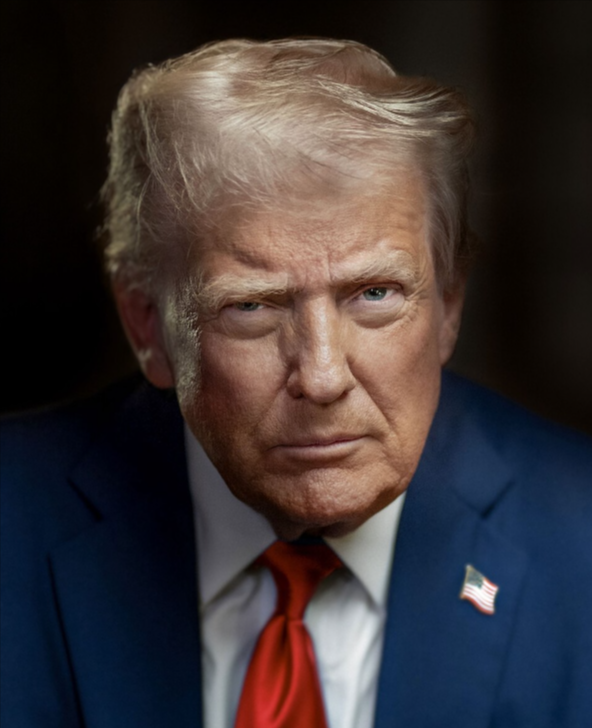
Editorial. In the spring of 2026, the United States finds itself governed by a president whose every major initiative reads less like statecraft than the compulsive script of a man unraveling under the weight of his own history. Donald J. Trump’s second term has not been a continuation of conservative governance; it has been a theater of the absurd staged by a figure who treats the republic as personal property, foreign capitals as bargaining chips, and the rule of law as an inconvenience to be managed through spectacle. The pattern is unmistakable: grandiose territorial fantasies, extralegal abductions, tariff theater that markets have learned to price in as “TACO” volatility, unilateral wars followed by hasty cease-fires, and the quiet bureaucratic strangulation of documents that might illuminate the president’s own past associations. At the center of this maelstrom sits the Epstein files—millions of pages released under legislation Trump himself signed, yet riddled with redactions, deletions, and outright withholdings precisely where his name surfaces in allegations of sexual misconduct with a minor.
The question this editorial forces upon the reader is not merely whether these actions constitute bad policy. It is whether they constitute a deliberate strategy of distraction and impunity. Has the president, consciously or through the logic of narcissistic self-preservation, engineered a cascade of international crises to render any serious domestic accounting of his past impossible? To answer requires a sober recapitulation of the record, an unflinching examination of each episode, and a philosophical reckoning with the nature of power when it is seized by a man who views accountability as weakness.
I. The First Term as Prologue: Competence, Chaos, and the Cultivation of Impunity
Trump’s first presidency (2017–2021) offered the nation a contradictory inheritance. On the economic front, pre-pandemic growth was robust: unemployment reached historic lows, wage gains finally reached the bottom quintile, energy independence became reality, and the Tax Cuts and Jobs Act of 2017 delivered measurable supply-side stimulus. The Abraham Accords demonstrated that personal diplomacy, untethered from conventional State Department pieties, could reorder Middle Eastern alignments. Criminal-justice reform via the First Step Act showed occasional bipartisan pragmatism.
Yet beneath these outcomes lay a deeper rot: the erosion of institutional norms. Two impeachments, one for soliciting foreign interference in an election, the other for inciting an insurrection after refusing to accept electoral defeat. A revolving door of senior officials dismissed by tweet. The deliberate hollowing of the civil service. Most ominously, the cultivation of a cult of personality that treated criticism as treason and loyalty as the sole qualification for office. When COVID-19 arrived, the president’s blend of denial, quackery, and blame-shifting produced one of the developed world’s highest per-capita death tolls. Deficits ballooned not from Keynesian necessity but from ideological tax cuts timed for re-election.
The first term, in short, established the template: substantive policy wins could coexist with constitutional vandalism and personal grievance. The man who left office in 2021 had already demonstrated that the presidency could be bent toward self-exculpation. The second term would test how far that logic could be extended once the guardrails of opposition Congress and a hostile press were removed.
II. Imperial Daydreams: Greenland, Canada, and the Return of Manifest Destiny
Within weeks of inauguration, Trump revived his 2019 fixation on acquiring Greenland. He appointed a special envoy, floated tariffs on Denmark and broader Europe, and refused to rule out “military or economic force.” Maps circulated showing the island as American territory; AI-generated images depicted him planting the Stars and Stripes beside JD Vance and Marco Rubio. The rationale—national security against Russian and Chinese encroachment in the Arctic—was not frivolous. The strategic logic, however, was subordinated to spectacle. Denmark and Greenland rejected the overtures; NATO allies recoiled; the president eventually pivoted to “negotiated sovereign claims” after Davos talks. The episode revealed not prudent realpolitik but a monarchic impulse: the belief that great powers may simply purchase or pressure weaker partners into ceding territory.
Parallel rhetoric targeted Canada. Trump repeatedly mused that the northern neighbor “wants to be the 51st state,” deploying 25 percent tariff threats as leverage in trade talks. The phrase “economic force” became his euphemism for coercion short of invasion. Canadian Prime Minister Justin Trudeau was mocked as “governor” of the “Great State of Canada.” Again, legitimate grievances about dairy, lumber, and border security existed. What did not exist was any constitutional or international warrant for treating a sovereign democracy as a candidate for annexation. The pattern was clear: Trump’s foreign policy increasingly resembled the nineteenth-century expansionism of filibusters and land speculators, updated for the age of social media.
These fantasies are not harmless bluster. They poison alliances, invite reciprocal predation by authoritarian states, and signal to the world that American power is now personal whim rather than predictable interest. They also serve a domestic function: each new territorial provocation dominates cable news cycles, crowds out domestic scandals, and rallies the base around images of American greatness restored.
III. The Maduro Operation: Kidnapping as Counter-Narcotics Policy
On 3 January 2026, U.S. special forces, supported by air and naval assets, struck targets in Caracas. Nicolás Maduro and his wife Cilia Flores were seized and flown to New York to face long-standing drug-trafficking indictments tied to the so-called Cartel de los Soles. Venezuelan officials and international legal scholars immediately labeled the action a kidnapping. Casualties mounted; sovereignty was violated; the precedent set was chilling.
The administration framed the raid as law enforcement writ large. Yet the operation lacked congressional authorization, bypassed extradition treaties, and occurred on the sovereign territory of a state with which the United States was not at war. Legal experts across the ideological spectrum condemned it as a breach of the UN Charter and customary international law. Even if Maduro’s regime was criminal—which the evidence of narco-state behavior strongly suggests—the remedy was not unilateral abduction.
The raid’s timing and execution reveal deeper motives. Venezuela’s oil reserves and proximity to Caribbean migration routes made regime change attractive. Yet the method—commando seizure of a sitting head of state—crossed a Rubicon. It normalized the idea that the United States may treat foreign leaders as fugitives whenever domestic politics or resource interests align. It also provided weeks of triumphant headlines: “Maduro in Chains,” “Trump Delivers Justice.” The domestic political dividend was immediate.
IV. Tariff Theater and the TACO Trade: Economic Policy as Performance Art
Wall Street coined the acronym early: TACO—Trump Always Chickens Out. The pattern is now ritual. Announce eye-watering tariffs—50 percent on copper, 200 percent on pharmaceuticals, blanket levies on Canada, Mexico, China. Markets plunge. Then, within days or weeks, delays, exemptions, “negotiations,” or outright cancellations. Stocks rebound. Traders call it the TACO trade: buy the dip, sell the relief rally.
The economic consequences are not trivial. Supply chains fracture, inflation ticks upward, retaliatory measures from trading partners accumulate. Yet the president treats tariffs less as instruments of industrial policy than as opening bids in perpetual deal-making. The Liberation Day tariff package of 2025 was the archetype: maximalist threats followed by serial retreats. The result is policy incoherence dressed as strategic genius.
Critics rightly note that Trump inherited a global trading system tilted against American manufacturing. The remedy, however, is not episodic chaos but coherent reciprocity and domestic investment. TACO volatility erodes investor confidence, raises consumer costs, and damages the very working-class constituencies the president claims to champion. Once again, spectacle substitutes for strategy.
V. The Iran War: From Ultimatum to Cease-Fire, with American Blood and Treasure
In late February 2026, Trump authorized Operation Epic Fury—coordinated U.S.-Israeli strikes on Iranian nuclear facilities, command nodes, and proxy infrastructure. The Strait of Hormuz was blockaded; Iranian boats were sunk; infrastructure threats were issued. Oil prices spiked, global markets convulsed, and the region teetered on wider war. By April the president notified Congress that hostilities had “terminated” after a fragile cease-fire.
The legal basis was tenuous. The 2002 AUMF was stretched beyond recognition. Congressional war powers were treated as advisory. The human and strategic costs—civilian casualties, Iranian retaliation, strain on U.S. forces—are still being tallied.
The episode fits the emerging pattern: bold military gesture followed by negotiated de-escalation once political capital is banked. Iran’s nuclear program was set back but not dismantled. Regional alliances were strained. And once more, foreign crisis dominated the domestic conversation.
VI. The German Troop Withdrawal: Punishing Allies, Weakening NATO
In early May 2026, the Pentagon announced the withdrawal of 5,000 U.S. troops from Germany, with Trump hinting at far deeper cuts. The trigger was explicit: German Chancellor Friedrich Merz’s public criticism of U.S. handling of the Iran conflict, which he described as “humiliating.”
The move echoes first-term threats but now carries execution. It signals contempt for NATO burden-sharing rhetoric when allies dare voice strategic disagreement. It weakens the eastern flank at a moment when Russian and Chinese revisionism remains active. Most cynically, it transforms alliance management into personal score-settling.
VII. The Epstein Files: The Cover-Up at the Heart of the Madness
Here the narrative converges. In November 2025 Trump signed the Epstein Files Transparency Act. Millions of pages were released in waves through early 2026. Yet NPR, The New York Times, congressional Democrats, and independent watchdogs documented systematic omissions: pages detailing an unverified but specific accusation that Trump sexually abused a minor introduced to him by Epstein in the 1980s; photographs of Trump, Epstein, and Ghislaine Maxwell together; FBI 302 memos mentioning the president. The Department of Justice, under Trump appointees, cited “privilege,” “ongoing investigations,” or simple “review” to justify withholdings and removals. A GAO probe is now underway. Public polling shows widespread suspicion of a cover-up.
Trump’s own history with Epstein is not in dispute: social acquaintance in the 1980s and 1990s, at least one documented flight on the “Lolita Express,” the infamous 2002 New York Magazine quote describing Epstein as a “terrific guy” who likes “beautiful women… many of them on the younger side.” A later falling-out and ban from Mar-a-Lago occurred around 2007. Trump has never been charged with any Epstein-related crime, and he has pointed to his 2006 tip-off to Palm Beach police as evidence of civic duty.
Yet the selective sanitization of the files under his own administration raises the unavoidable question: are the foreign-policy convulsions of 2025–2026—Greenland threats, Canadian economic pressure, the Maduro abduction, TACO tariff drama, the Iran strikes, the German troop cuts—partially engineered to render serious scrutiny of these files politically untenable?
Consider the timing. Major Epstein document dumps coincided with peaks of international crisis. Each new foreign drama consumed media oxygen. Congressional oversight was diverted. Public attention fragmented. The DOJ, staffed by loyalists, controlled the release process. The president’s own rhetoric dismissed the entire Epstein matter as a “Democrat hoax” even as his administration implemented the transparency law in the most opaque manner possible.
This is not proof of criminality. It is, however, compelling circumstantial evidence of motive. Power, as Lord Acton observed, tends to corrupt; absolute power, when wedded to personal legal vulnerability, tends to produce distraction on a geopolitical scale. The classical tyrants of antiquity—Nero’s games, Caligula’s provocations—understood that spectacle could shield vice. Modern autocrats have updated the formula with 24-hour news cycles and algorithmic amplification. Trump’s “madness,” if that is the word, may be less clinical insanity than the rational (if sociopathic) calculus of a man who has learned that chaos is the best defense against accountability.
Philosophically, this raises deeper questions about the American constitutional order. The Framers designed a system of separated powers precisely to prevent any single individual from subordinating the national interest to private salvation. When the executive branch controls both foreign policy and the administration of justice, and when that executive faces credible allegations of past misconduct, the temptation to conflate the two becomes overwhelming. Hannah Arendt warned of the “banality of evil” arising from thoughtless obedience; here we witness something more active: the instrumentalization of evil—real or alleged—to justify perpetual motion.
VIII. Broader Implications: The Republic at Risk
The cumulative effect of these actions is not merely policy failure. It is institutional corrosion. Alliances fray. International law becomes optional. Markets learn to discount presidential words. The public, exhausted by manufactured crises, grows cynical about truth itself. Most dangerously, the precedent is set that a president may use the instruments of state—military, economic, bureaucratic—to shield himself from scrutiny.
Democrats decry authoritarianism; Republicans cheer “winning.” Both miss the deeper tragedy: the slow hollowing of the republic into a personal fiefdom. The Epstein files episode crystallizes the danger. If even the most explosive transparency law in recent memory can be neutered by the very administration tasked with enforcing it, then no statute, no norm, no constitutional safeguard is safe.
IX. Conclusion: Beyond the Madman
Donald Trump is not mad in the clinical sense. He is, rather, the logical endpoint of a political culture that rewards spectacle over substance, grievance over governance, and personal loyalty over institutional fidelity. His second term has been a masterclass in the uses of chaos: territorial fantasies to feed nationalist appetite, abductions to project strength, tariff theater to simulate economic warfare, wars begun and paused to dominate headlines, and the quiet burial of inconvenient documents to preserve impunity.
The Epstein files stand as the silent indictment. Their selective suppression, timed against a backdrop of perpetual international emergency, suggests a president who understands that accountability is the one enemy he cannot tariff, annex, or bomb into submission. Whether this constitutes deliberate strategy or emergent pattern is, in the end, secondary. The effect is the same: a republic governed by distraction, a world order destabilized by caprice, and a leader whose every action whispers the same imperative—survive, dominate, never yield to judgment.
Americans must decide whether this is the future they desire. The madman does not govern alone. He governs because enough of us have mistaken his frenzy for vitality. The remedy is not impeachment theater or partisan rage but a renewed commitment to constitutional restraint, transparent institutions, and the unglamorous work of self-government. Without it, the next crisis—manufactured or real—will only deepen the pattern. History judges not only the madmen but the societies that empowered them. The verdict, as of May 2026, remains pending.